ABOUT THE PRODUCT
ABOUT THE MANUFACTURER
GLOSSARY
HALO-C
Compact passive line array element
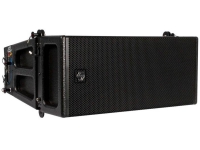
The HALO-C line array element is the main component of the system – delivering breathtaking sonic detail through the use of its AMT high frequency drive unit and bespoke waveguide. Completely passive, with an output SPL which defies its diminuitive size, HALO-C is what makes the HALO Compact system redefine what is possible from a “compact” line array.
Features
- True plane wave output waveguide provides seamless array integration
- Consistent 95° horizontal dispersion pattern
- Integral four-point flying system supports up to 24 elements with 10:1 safety factor
- Premium 12mm and 18mm multi-laminate birch plywood cabinet
- Perforated stainless steel grille with acoustically transparent fabric backing
- CASE-HALO-C four element touring flightcase optionally available
- Impact and weather resistant black or white textured finish as standard
- RAL colour and enhanced weather protection options
HALO-C is a development from the original HALO system, keeping the same breathtaking sonic performance that the original HALO system was known for. HALO-C is a truly compact solution – yet as it is capable of continuous sound pressure levels in excess of 120dB it is an ideal solution for small-to-medium theatres, houses of worship, conference & corporate A/V and even small to medium scale live sound reinforcement.
HALO-C contains a 197mm (7.8″) AMT high frequency drive unit on a bespoke waveguide, linked via a signature EM Acoustics passive crossover to a high power neodymium 8″ (203mm) LF drive unit. Exact drive unit placement, coupled with the crossover topology and waveguide design extends the horizontal coverage pattern to below 1kHz. The true plane wave output of the AMT drive unit and waveguide combination yields a precise, well-behaved vertical pattern allowing seamless array integration and minimising destructive interference between adjacent elements.
The HALO Compact enclosure is constructed from premium multi-laminate birch plywood, and is only 492mm (19.4″) wide and 17kg (37.4lbs) in weight. Intelligent bracing design minimises panel flexure, thereby reducing unwanted resonance whilst still keeping the enclosure weight low. The design of the rigging hardware is flexible for use in both flown and ground stacked configurations, and allows arrays of up to 24 elements to be assembled whilst retaining a 10:1 safety factor.
A perforated stainless steel grille backed with acoustically transparent fabric finishes the enclosure with a sleek but stylish appearance. Two NL4 connections are provided on the rear for input and enclosure link. The enclosure is finished in an impact and weather resistant black or white textured polyurethane finish as standard, though RAL colour matching and enhanced weather-protected outdoor options are available.
HALO-C requires a single amplifier channel, and the use of external DSP is recommended for system protection with high pass filters and limiters – as such it is recommended to be used with EM Acoustics’ range of Advanced System Amplifiers. It is however possible to use other DSP-enabled amplifiers, or conventional amplifiers with external DSP. Suitable DSP settings are provided on the EM Acoustics website. HALO-C requires a single amplifier channel capable of delivering 500-800W RMS into an 8-ohm load.
Specifications
- Enclosure Type: Two-way passive compact line array element
- Components: 1 x 8” (203mm) neodymium LF drive unit / 1 x 7.8” (197mm) neodymium AMT HF drive unit
- Dimensions (HxWxD), mm/(ins): 216 (8.5) x 492 (19.4) x 400 (15.7) mm/(ins) – enclosure only / 252 (9.9) x 524 (20.6) x 400 (15.7) mm/(ins) – extremities of rigging/pins
- Net/Shipping Weight: 17/19kg (37.4/41.8lbs)
- Frequency Response: 75Hz – 20kHz ± 3dB
- Nominal Dispersion: 95° horizontal, vertical dependant on array configuration
- Maximum SPL: 124dB continuous, 130dB peak
- Loudspeakers per amplifier (for full SPL output)*: DQ6: 2 per channel, DQ10: 4 per channel, DQ20: 4 per channel / Di06: 1 per channel, Di10: 2 per channel, Di20: 3 per channel
- Power Handling: 325W RMS, 650W program
- Nominal Impedance: 8 ohms
- Crossover: Asymmetric internal passive
Professional used lighting equipment.| Professional second hand lighting equipment.| Professional pre owned lighting equipment.
Professional used audio equipment.| Professional second hand audio equipment.| Professional pre owned audio equipment.
Second hand audio gear. | Second hand lighting.
Pro audio equipment, second hand amplifiers, DJ, second hand sound systems, second hand Microphones, second hand Media Players.
Outdoor & Indoor LED screens for sale, LED mobile truck.
Light trussing, Gebrauchte Veranstaltungstechnik, used stage equipment Stage & Theatre lighting products.
Used EM Acoustics
EM Acoustics is an independent British manufacturer of high-end professional loudspeaker systems. From modest beginnings in 2002 we set out to redefine the performance standards expected of passive loudspeakers. We believed that burdensome and unnecessary electronic complexity could get in the way of the fundamental goal of sound reinforcement: fidelity, accuracy, and ultimate headroom. Early commercial success was achieved with a redefined, back-to-first-principles approach to the passive crossover technology that is at the core of the product range.
Combining precision engineering with robust build quality, our products are designed to deliver top-class performance throughout the demand curve, backed up by one-to-one customer support for the life of the product. Using state-of-the-art automation as well as skilled craftwork, we handle our own woodwork and paint processes, circuitry, conduct final assembly and comprehensively test in a modern 26,000 square foot factory in the heart of Surrey, England using a dedicated local workforce. We achieve as much of the manufacturing process in house as is possible, sourcing components and materials from elite suppliers. Our flexible design-to-prototype workflow is so streamlined as to allow us to accommodate special customer requirements and even one-offs.
Our extensive R&D facility enables the pursuit of both free- thinking acoustics research as well as the rapid development of commercially proven, market-leading solutions, based on a firmly held belief that the highest quality components and enclosures result in loudspeakers notable for their absolute neutrality and accuracy of sound.
The use of natural materials, as opposed to plastics, in the fundamental structure of our products is an entirely conscious decision that is as good for the listener as it is for the wider environment.
We measure, we listen, and we critically assess every aspect of every loudspeaker’s performance before it becomes a part of your system, and our confidence in our production and quality control procedures is backed by a five-year warranty.
As a company we pride ourselves on being highly approachable, communicative, and responsible. Founders Ed Kinsella and Mike Wheeler are just a phone call away and are often seen at the sharp end of an install or live event; the real world of live production is really the only place to fully absorb what’s going on in sound reinforcement, and this approach allows us to bring fresh thinking to product design and respond to customer feedback quickly and positively.
We strive for inclusiveness and integrity, pursuing admittedly high ideals and fundamental values like one-to-one customer support and pride in workmanship and workforce. We’re unashamedly devoted to keeping things simple – using natural materials, avoiding complicated processing where it’s not needed, supporting sustainable ideals wherever possible, and designing out anything that gets in the way of enjoying the show and our clients’ ability to deliver their audio, their way.
Professional used lighting equipment.| Professional second hand lighting equipment.| Professional pre owned lighting equipment.
Professional used audio equipment.| Professional second hand audio equipment.| Professional pre owned audio equipment.
Second hand audio gear. | Second hand lighting.
Pro audio equipment, second hand amplifiers, DJ, second hand sound systems, second hand Microphones, second hand Media Players.
Outdoor & Indoor LED screens for sale, LED mobile truck.
Light trussing, Gebrauchte Veranstaltungstechnik, used stage equipment Stage & Theatre lighting products.
Active: Powered. An active crossover is electrically powered and divides the line-level signal prior to amplification. An active speaker includes an active crossover and built-in amplifier.
Actuality: Audio from an announcer speaking.
Amplifier: A component that increases the gain or level of an audio signal.
Balanced Input: A connection with three conductors: two identical signal conductors that are 180 degrees out of phase with each other, and one ground. This type of connection is very resistant to line noise.
Bandpass: A two-part filter that cuts both higher and lower frequencies around a center band. A bandpass enclosure cuts high frequencies by acoustic cancellation and low frequencies by natural physical limitations on bass response.
Bandwidth: In audio, the range of frequencies a device operates within. In video, the range of frequencies passed from the input to the output. Bandwidth can also refer to the transmission capacity of an electronic communications device or system the speed of data transfer,is very important when planning a meeting for the attendees to stay connected.
Bass: Low frequencies those below approximately 200 Hz.
Bi-Wiring: A method of connecting an amplifier or receiver to a speaker in which separate wires are run between the amp and the woofer and the amp and the tweeter.
Boost: To increase, make louder or brighter opposite of attenuate.
Bridging: Combining two channels of an amplifier to make one channel that more powerful. One channel amplifies the positive portion of an audio signal and the other channel amplifies the negative portion, which are then combined at the output.
CD: Compact Disc. Ubiquitous digital audio format. Uses 16-bit/44.1-kHz sampling rate PCM digital signal to encode roughly 74 or 80 minutes of two- channel, full-range audio onto a 5-inch disc.
CD-R: Recordable Compact Disc.
CD-RW: Rewritable Compact Disc.
Channel: In components and systems, a channel is a separate signal path. A four-channel amplifier has at least four separate inputs and four separate outputs.
Coloration: Any change in the character of sound (such as an overemphasis on certain tones) that reduces naturalness.
Crossover: A component that divides an audio signal into two or more ranges by frequency, sending, for example, low frequencies to one output and high frequencies to another. An active crossover is powered and divides the line-level audio signal prior to amplification. A passive crossover uses no external power supply and may be used either at line level or, more commonly, at speaker level to divide the signal after amplification and send the low frequencies to the woofer and the high frequencies to the tweeter.
Crossover Frequency: The frequency at which an audio signal is divided. 80 Hz is a typical subwoofer crossover point and is the recommended crossover point in theatrical and home THX systems. Frequencies below 80 Hz are sent to the subwoofer signals above 80 Hz are sent to the main speakers.
Cut: To reduce, lower opposite of boost.
Decibel (dB): A logarithmic measurement unit that describes a sound`s relative loudness, though it can also be used to describe the relative difference between two power levels. A decibel is one tenth of a Bel. In sound, decibels generally measure a scale from 0 (the threshold of hearing) to 120-140 dB (the threshold of pain). A 3dB difference equates to a doubling of power. A 10dB difference is required to double the subjective volume. A 1dB difference over a broad frequency range is noticeable to most people, while a 0.2dB difference can affect the subjective impression of a sound.
Delay: The time difference between a sonic event and its perception at the listening position (sound traveling through space is delayed according to the distance it travels). People perceive spaciousness by the delay between the arrival of direct and reflected sound (larger spaces cause longer delays.
Diaphragm: The part of a dynamic loudspeaker attached to the voice coil that produces sound. It usually has the shape of a cone or dome.
Diffusion: In audio, the scattering of sound waves, reducing the sense of localization. In video, the scattering of light waves, reducing hot spotting, as in a diffusion screen.
Digital Audio Server: Essentially a hard drive, a digital audio server stores compressed audio files (like MP3 or WMA). Most include the processing to make the files, and all have the ability to play them back.
Direct-Stream Digital: A format for encoding high-resolution audio signals. It uses a 1-bit encoder with a sampling rate of 2,822,400 samples per second (verses 44,100 for CD). Used to encode six high-resolution channels on SACD.
Dispersion: The spread of sound over a wide area.
Distortion: Any undesired change in an audio signal between input and the output.
DNR: Dynamic Noise Reduction. A signal-processing circuit that attempts to reduce the level of high-frequency noise. Unlike Dolby NR, DNR doesn't require preprocessing during recording.
Dolby B: A noise-reduction system that increases the level of high frequencies during recording and decreases them during playback.
Dolby C: An improvement on Dolby B that provides about twice as much noise reduction.
Dolby Digital: An encoding system that digitally compresses up to 5.1 discrete channels of audio (left front, center, right front, left surround, right surround, and LFE) into a single bitstream, which can be recorded onto a DVD, HDTV broadcast, or other form of digital media. When RF-modulated, it was included on some laser discs, which requires an RF-demodulator before the signal can be decoded. Five channels are full-range the .1 channel is a band-limited LFE track. A Dolby Digital processor (found in most new receivers, preamps, and some DVD players) can decode this signal back into the 5.1 separate channels. Most films since 1992`s Batman Returns have been recorded in a 5.1 digital format, though a number of films before that had 6-channel analog tracks that have been remastered into 5.1.
Dolby EX: An enhancement to Dolby Digital that adds a surround back channel to 5.1 soundtracks. The sixth channel is matrixed from the left and right surround channels. Often referred to as 6.1. Sometimes referred to as 7.1 if the system uses two surround back speakers, even though both speakers reproduce the same signal. Software is backwards-compatible with 5.1 systems, but requires an EX or 6.1 processor to obtain additional benefit.
Dolby Pro Logic: An enhancement of the Dolby Surround decoding process. Pro Logic decoders derive left, center, right, and a mono surround channel from two-channel Dolby Surround encoded material via matrix techniques.
Dolby Pro Logic II: An enhanced version of Pro Logic. Adds improved decoding for two-channel, non-encoded soundtracks and music.
Driver: A speaker without an enclosure also refers to the active element of a speaker system that creates compressions and rarefactions in the air.
DSP: Digital Signal Processing. Manipulating an audio signal digitally to create various possible effects at the output. Often refers to artificially generated surround effects derived from and applied to two-channel sources.
DTS: Digital Theater Systems. A digital sound recording format, originally developed for theatrical film soundtracks, starting with Jurassic Park. Records 5.1 discrete channels of audio onto a handful of laser discs, CDs, and DVDs. Requires a player with DTS output connected to a DTS processor.
DTS ES: An enhanced version of the 5.1 DTS system. Like Dolby's Surround EX, a sixth channel is added. In some cases (DTS ES Discrete), the sixth channel is discrete. Software is backwards-compatible with 5.1 systems, but requires an ES or 6.1 processor to obtain additional benefit. Neo: 6 is a subset of DTS ES that creates 6.1 from material with fewer original channels.
Dynamic Range: The difference between the lowest and the highest levels in audio, it&'s often expressed in decibels. In video, it's listed as the contrast ratio.
Professional used lighting equipment.| Professional second hand lighting equipment.| Professional pre owned lighting equipment.
Professional used audio equipment.| Professional second hand audio equipment.| Professional pre owned audio equipment.
Second hand audio gear. | Second hand lighting.
Pro audio equipment, second hand amplifiers, DJ, second hand sound systems, second hand Microphones, second hand Media Players.
Outdoor & Indoor LED screens for sale, LED mobile truck.
Light trussing, Gebrauchte Veranstaltungstechnik, used stage equipment Stage & Theatre lighting products.
Recently viewed
Product Brands