ABOUT THE PRODUCT
ABOUT THE MANUFACTURER
GLOSSARY
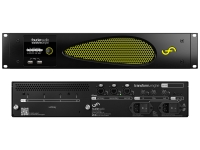
transform.engine
audio plugins, live.
transform.engine brings studio-grade audio software plugins to productions and broadcasts around the world, in a robust 2U rackmount server.
any plugin, live.
transform.engine runs VST3 or CLAP plugins, giving engineers and creatives access to the very best studio-grade processing on a robust platform that is specifically designed for the complexities of live productions
reliability at its heart.
Fourier Audio’s patent-pending audio engine provides a rock-solid plugin sandbox. Should a plugin crash, other chains continue unaffected, and transform.engine restarts the culprit before you realise it failed.
under your fingers.
transform.engine delivers in-console integration and control of any plugin on DiGiCo Quantum consoles.
need for speed.
transform.engine has been tuned to deliver a lightning fast minimum of 1.2ms* roundtrip latency. The fastest cross-brand VST3 plugin hosting solution on the market. *HYPERPORT available in March’26
get going in seconds.
Designed as a turn-key solution for plugin hosting, transform.engine is easily controlled by a remote client application. No more relying on complex setups – simply connect to the engine, install your plugins and get processing!
multi-lingual audio.
With native support for Dante, HYPERPORT*, gigaACE*, DX*, and AES67 (via Dante), transform.engine can talk directly to almost any modern digital console or audio network: no converters necessary. *available March’26
effortless control with transform.client
Packed with features for easy installation, control and recalling of your plugins, including:
- Customisable plugin views: with chains chain views and our favourite, Gridview
- Cuelists: store and recall plugin data in multiple cuelists, recallable in the client, by MIDI, or with console integration
- Preset management: giving you the power to store, copy and paste settings across plugins
- Detailed DSP load monitoring: to assist you in balancing your DSP usage
Professional used lighting equipment.| Professional second hand lighting equipment.| Professional pre owned lighting equipment.
Professional used audio equipment.| Professional second hand audio equipment.| Professional pre owned audio equipment.
Second hand audio gear. | Second hand lighting.
Pro audio equipment, second hand amplifiers, DJ, second hand sound systems, second hand Microphones, second hand Media Players.
Outdoor & Indoor LED screens for sale, LED mobile truck.
Light trussing, Gebrauchte Veranstaltungstechnik, used stage equipment Stage & Theatre lighting products.
Used fourier audio ltd.
We are a team of software engineers, sound designers, and dreamers, setting out to change the way live audio is processed and delivered.
Our mission is to revolutionise live audio, making it more efficient, accessible, and extraordinary for everyone.
Currently, the vast majority of the world’s live audio is processed using bulky, bespoke hardware, toured around the world. This is expensive and inefficient, increasing the cost of live audio for both the engineer and the venue, and the production’s environmental impact. We are bringing the software revolution to live audio: building a hardware-enabled audio software platform that enables engineers to create extraordinary audience experiences for the events of the future, while reducing the environmental impact of brilliant sound.
Professional used lighting equipment.| Professional second hand lighting equipment.| Professional pre owned lighting equipment.
Professional used audio equipment.| Professional second hand audio equipment.| Professional pre owned audio equipment.
Second hand audio gear. | Second hand lighting.
Pro audio equipment, second hand amplifiers, DJ, second hand sound systems, second hand Microphones, second hand Media Players.
Outdoor & Indoor LED screens for sale, LED mobile truck.
Light trussing, Gebrauchte Veranstaltungstechnik, used stage equipment Stage & Theatre lighting products.
Active: Powered. An active crossover is electrically powered and divides the line-level signal prior to amplification. An active speaker includes an active crossover and built-in amplifier.
Actuality: Audio from an announcer speaking.
Amplifier: A component that increases the gain or level of an audio signal.
Balanced Input: A connection with three conductors: two identical signal conductors that are 180 degrees out of phase with each other, and one ground. This type of connection is very resistant to line noise.
Bandpass: A two-part filter that cuts both higher and lower frequencies around a center band. A bandpass enclosure cuts high frequencies by acoustic cancellation and low frequencies by natural physical limitations on bass response.
Bandwidth: In audio, the range of frequencies a device operates within. In video, the range of frequencies passed from the input to the output. Bandwidth can also refer to the transmission capacity of an electronic communications device or system the speed of data transfer,is very important when planning a meeting for the attendees to stay connected.
Bass: Low frequencies those below approximately 200 Hz.
Bi-Wiring: A method of connecting an amplifier or receiver to a speaker in which separate wires are run between the amp and the woofer and the amp and the tweeter.
Boost: To increase, make louder or brighter opposite of attenuate.
Bridging: Combining two channels of an amplifier to make one channel that more powerful. One channel amplifies the positive portion of an audio signal and the other channel amplifies the negative portion, which are then combined at the output.
CD: Compact Disc. Ubiquitous digital audio format. Uses 16-bit/44.1-kHz sampling rate PCM digital signal to encode roughly 74 or 80 minutes of two- channel, full-range audio onto a 5-inch disc.
CD-R: Recordable Compact Disc.
CD-RW: Rewritable Compact Disc.
Channel: In components and systems, a channel is a separate signal path. A four-channel amplifier has at least four separate inputs and four separate outputs.
Coloration: Any change in the character of sound (such as an overemphasis on certain tones) that reduces naturalness.
Crossover: A component that divides an audio signal into two or more ranges by frequency, sending, for example, low frequencies to one output and high frequencies to another. An active crossover is powered and divides the line-level audio signal prior to amplification. A passive crossover uses no external power supply and may be used either at line level or, more commonly, at speaker level to divide the signal after amplification and send the low frequencies to the woofer and the high frequencies to the tweeter.
Crossover Frequency: The frequency at which an audio signal is divided. 80 Hz is a typical subwoofer crossover point and is the recommended crossover point in theatrical and home THX systems. Frequencies below 80 Hz are sent to the subwoofer signals above 80 Hz are sent to the main speakers.
Cut: To reduce, lower opposite of boost.
Decibel (dB): A logarithmic measurement unit that describes a sound`s relative loudness, though it can also be used to describe the relative difference between two power levels. A decibel is one tenth of a Bel. In sound, decibels generally measure a scale from 0 (the threshold of hearing) to 120-140 dB (the threshold of pain). A 3dB difference equates to a doubling of power. A 10dB difference is required to double the subjective volume. A 1dB difference over a broad frequency range is noticeable to most people, while a 0.2dB difference can affect the subjective impression of a sound.
Delay: The time difference between a sonic event and its perception at the listening position (sound traveling through space is delayed according to the distance it travels). People perceive spaciousness by the delay between the arrival of direct and reflected sound (larger spaces cause longer delays.
Diaphragm: The part of a dynamic loudspeaker attached to the voice coil that produces sound. It usually has the shape of a cone or dome.
Diffusion: In audio, the scattering of sound waves, reducing the sense of localization. In video, the scattering of light waves, reducing hot spotting, as in a diffusion screen.
Digital Audio Server: Essentially a hard drive, a digital audio server stores compressed audio files (like MP3 or WMA). Most include the processing to make the files, and all have the ability to play them back.
Direct-Stream Digital: A format for encoding high-resolution audio signals. It uses a 1-bit encoder with a sampling rate of 2,822,400 samples per second (verses 44,100 for CD). Used to encode six high-resolution channels on SACD.
Dispersion: The spread of sound over a wide area.
Distortion: Any undesired change in an audio signal between input and the output.
DNR: Dynamic Noise Reduction. A signal-processing circuit that attempts to reduce the level of high-frequency noise. Unlike Dolby NR, DNR doesn't require preprocessing during recording.
Dolby B: A noise-reduction system that increases the level of high frequencies during recording and decreases them during playback.
Dolby C: An improvement on Dolby B that provides about twice as much noise reduction.
Dolby Digital: An encoding system that digitally compresses up to 5.1 discrete channels of audio (left front, center, right front, left surround, right surround, and LFE) into a single bitstream, which can be recorded onto a DVD, HDTV broadcast, or other form of digital media. When RF-modulated, it was included on some laser discs, which requires an RF-demodulator before the signal can be decoded. Five channels are full-range the .1 channel is a band-limited LFE track. A Dolby Digital processor (found in most new receivers, preamps, and some DVD players) can decode this signal back into the 5.1 separate channels. Most films since 1992`s Batman Returns have been recorded in a 5.1 digital format, though a number of films before that had 6-channel analog tracks that have been remastered into 5.1.
Dolby EX: An enhancement to Dolby Digital that adds a surround back channel to 5.1 soundtracks. The sixth channel is matrixed from the left and right surround channels. Often referred to as 6.1. Sometimes referred to as 7.1 if the system uses two surround back speakers, even though both speakers reproduce the same signal. Software is backwards-compatible with 5.1 systems, but requires an EX or 6.1 processor to obtain additional benefit.
Dolby Pro Logic: An enhancement of the Dolby Surround decoding process. Pro Logic decoders derive left, center, right, and a mono surround channel from two-channel Dolby Surround encoded material via matrix techniques.
Dolby Pro Logic II: An enhanced version of Pro Logic. Adds improved decoding for two-channel, non-encoded soundtracks and music.
Driver: A speaker without an enclosure also refers to the active element of a speaker system that creates compressions and rarefactions in the air.
DSP: Digital Signal Processing. Manipulating an audio signal digitally to create various possible effects at the output. Often refers to artificially generated surround effects derived from and applied to two-channel sources.
DTS: Digital Theater Systems. A digital sound recording format, originally developed for theatrical film soundtracks, starting with Jurassic Park. Records 5.1 discrete channels of audio onto a handful of laser discs, CDs, and DVDs. Requires a player with DTS output connected to a DTS processor.
DTS ES: An enhanced version of the 5.1 DTS system. Like Dolby's Surround EX, a sixth channel is added. In some cases (DTS ES Discrete), the sixth channel is discrete. Software is backwards-compatible with 5.1 systems, but requires an ES or 6.1 processor to obtain additional benefit. Neo: 6 is a subset of DTS ES that creates 6.1 from material with fewer original channels.
Dynamic Range: The difference between the lowest and the highest levels in audio, it&'s often expressed in decibels. In video, it's listed as the contrast ratio.
Professional used lighting equipment.| Professional second hand lighting equipment.| Professional pre owned lighting equipment.
Professional used audio equipment.| Professional second hand audio equipment.| Professional pre owned audio equipment.
Second hand audio gear. | Second hand lighting.
Pro audio equipment, second hand amplifiers, DJ, second hand sound systems, second hand Microphones, second hand Media Players.
Outdoor & Indoor LED screens for sale, LED mobile truck.
Light trussing, Gebrauchte Veranstaltungstechnik, used stage equipment Stage & Theatre lighting products.
Recently viewed
Product Brands